White HouseSenateThe HouseSupreme CourtFederal ReserveDOJState DepartmentTreasuryCensusBudget OfficeTrade Representative
WashingTone
Informed by Washington, Defined by Insight
Saturday, Apr 25, 2026
WashingTone

Washington Flag Error Exposes Fragility of Diplomatic Optics Ahead of King Charles Visit
A simple logistics mistake briefly replaced British symbols with Australian ones, underscoring how ceremonial precision shapes high-stakes diplomacy
A procedural breakdown in Washington’s event logistics — not a political dispute or diplomatic rift — triggered an unusual but revealing incident days before King Charles III’s state visit to the United States.
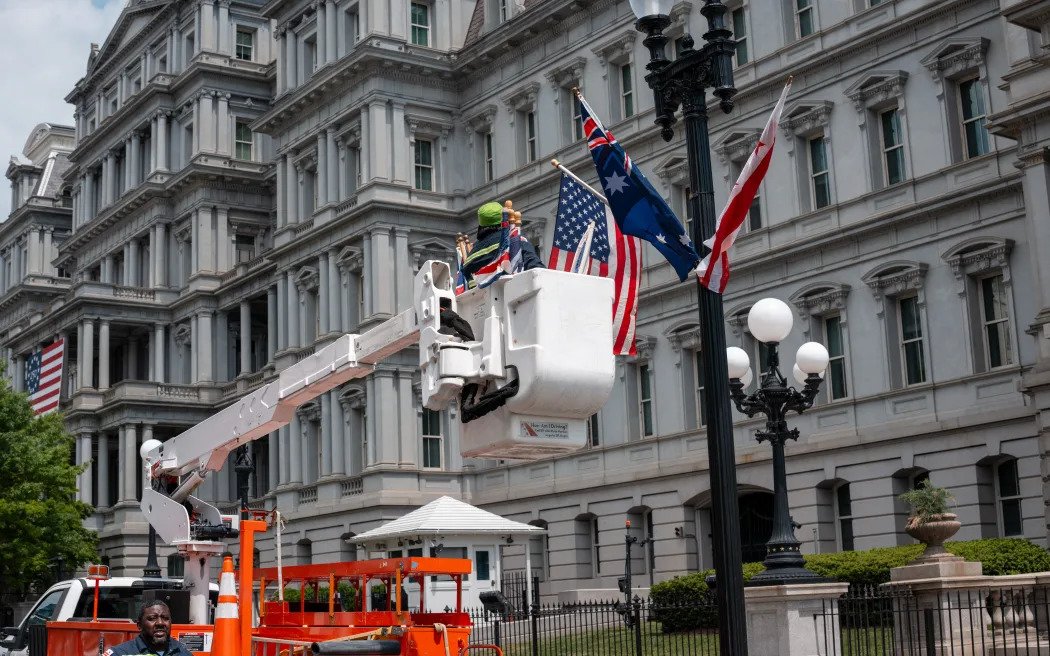
City crews mistakenly installed Australian flags instead of British ones near the White House, a visible error that was quickly corrected but highlighted how tightly managed symbolic gestures underpin modern diplomacy.
What is confirmed is that the District of Columbia placed about fifteen Australian flags among more than two hundred flags prepared to welcome the British monarch.
The flags were displayed along a central corridor near federal buildings, including areas close to the White House, before officials identified the mistake and replaced them with the Union Jack within hours.
The error originated within routine municipal operations.
The District’s transportation department, which is responsible for installing ceremonial street displays during state visits, said the flags are normally stored and labeled.
Officials are now reviewing whether the mix-up resulted from mislabeling or incorrect storage.
The mistake was geographically limited and did not affect the broader citywide preparations.
Mechanically, the incident reflects how state visits rely on standardized, often repetitive logistical systems: flags are pre-positioned, catalogued, and deployed at scale under tight timelines.
A failure at any point in that chain — storage, labeling, or distribution — can produce highly visible mistakes.
In this case, the visual similarity between the Australian and British flags, both incorporating the Union Jack, likely contributed to the confusion.
The timing amplified the sensitivity.
King Charles III’s visit is not routine: it coincides with the 250th anniversary of the United States’ Declaration of Independence, a milestone that carries historical weight given the break from British rule.
The visit is also positioned as a strategic effort to reinforce the U.S.–U.K. alliance at a moment of geopolitical strain, including tensions linked to the Iran conflict.
That context raises the stakes of even minor ceremonial missteps.
Diplomatic visits are choreographed to signal respect, continuity, and alignment.
Flags, in particular, are not decorative but communicative tools — they signal recognition of sovereignty and identity.
A mismatch, even accidental, can be read as inattentiveness or lack of preparation, especially when global attention is focused on the event.
The incident also carries a layer of constitutional nuance.
King Charles III is simultaneously the head of state of the United Kingdom and Australia, among other Commonwealth realms.
While that dual role offers a superficial explanation for the confusion, it does not change protocol: a visit conducted in his capacity as British monarch requires British national symbols.
The Australian flag’s presence was therefore incorrect despite the shared monarch.
Operationally, the rapid correction prevented escalation.
Officials removed and replaced the flags before the king’s arrival, ensuring that formal ceremonies and visual staging will align with diplomatic expectations.
The response suggests established contingency processes for correcting visible errors in high-profile preparations.
The broader implication is not about embarrassment but about system reliability.
Large-scale ceremonial events depend on decentralized execution — local agencies implementing national-level protocol.
When those systems falter, even briefly, they expose how much of diplomacy is conveyed through precise, often invisible coordination.
By the time King Charles III arrives in Washington, the visual landscape will reflect the intended message: a carefully staged reaffirmation of ties between the United States and the United Kingdom, with the earlier error reduced to a contained operational lapse rather than a diplomatic incident.
City crews mistakenly installed Australian flags instead of British ones near the White House, a visible error that was quickly corrected but highlighted how tightly managed symbolic gestures underpin modern diplomacy.
What is confirmed is that the District of Columbia placed about fifteen Australian flags among more than two hundred flags prepared to welcome the British monarch.
The flags were displayed along a central corridor near federal buildings, including areas close to the White House, before officials identified the mistake and replaced them with the Union Jack within hours.
The error originated within routine municipal operations.
The District’s transportation department, which is responsible for installing ceremonial street displays during state visits, said the flags are normally stored and labeled.
Officials are now reviewing whether the mix-up resulted from mislabeling or incorrect storage.
The mistake was geographically limited and did not affect the broader citywide preparations.
Mechanically, the incident reflects how state visits rely on standardized, often repetitive logistical systems: flags are pre-positioned, catalogued, and deployed at scale under tight timelines.
A failure at any point in that chain — storage, labeling, or distribution — can produce highly visible mistakes.
In this case, the visual similarity between the Australian and British flags, both incorporating the Union Jack, likely contributed to the confusion.
The timing amplified the sensitivity.
King Charles III’s visit is not routine: it coincides with the 250th anniversary of the United States’ Declaration of Independence, a milestone that carries historical weight given the break from British rule.
The visit is also positioned as a strategic effort to reinforce the U.S.–U.K. alliance at a moment of geopolitical strain, including tensions linked to the Iran conflict.
That context raises the stakes of even minor ceremonial missteps.
Diplomatic visits are choreographed to signal respect, continuity, and alignment.
Flags, in particular, are not decorative but communicative tools — they signal recognition of sovereignty and identity.
A mismatch, even accidental, can be read as inattentiveness or lack of preparation, especially when global attention is focused on the event.
The incident also carries a layer of constitutional nuance.
King Charles III is simultaneously the head of state of the United Kingdom and Australia, among other Commonwealth realms.
While that dual role offers a superficial explanation for the confusion, it does not change protocol: a visit conducted in his capacity as British monarch requires British national symbols.
The Australian flag’s presence was therefore incorrect despite the shared monarch.
Operationally, the rapid correction prevented escalation.
Officials removed and replaced the flags before the king’s arrival, ensuring that formal ceremonies and visual staging will align with diplomatic expectations.
The response suggests established contingency processes for correcting visible errors in high-profile preparations.
The broader implication is not about embarrassment but about system reliability.
Large-scale ceremonial events depend on decentralized execution — local agencies implementing national-level protocol.
When those systems falter, even briefly, they expose how much of diplomacy is conveyed through precise, often invisible coordination.
By the time King Charles III arrives in Washington, the visual landscape will reflect the intended message: a carefully staged reaffirmation of ties between the United States and the United Kingdom, with the earlier error reduced to a contained operational lapse rather than a diplomatic incident.