White HouseSenateThe HouseSupreme CourtFederal ReserveDOJState DepartmentTreasuryCensusBudget OfficeTrade Representative
WashingTone
Informed by Washington, Defined by Insight
Saturday, Apr 25, 2026
WashingTone

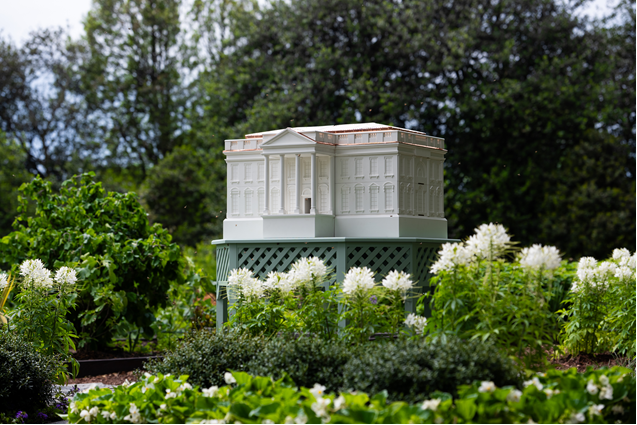
Melania Trump Adds White House-Shaped Beehive to South Lawn in Expansion of Presidential Honey Program
The South Lawn installation expands a long-running White House beekeeping program, increasing production, public engagement, and symbolic use of the executive grounds
A SYSTEM-DRIVEN development at the White House has added a new layer to one of its most unusual long-running traditions: beekeeping on the South Lawn.
First Lady Melania Trump has unveiled a new fully functioning beehive shaped like the White House, expanding an existing honey production program that has operated across multiple administrations since 2009.
What is confirmed is that the installation adds two additional bee colonies to the two already maintained on the White House grounds.
The structure was designed by White House residence staff and hand-crafted by a Virginia artisan in the likeness of the executive mansion.
It sits on the South Lawn, where the White House maintains gardens used for both symbolic and practical food production.
The expansion is expected to raise annual honey output by roughly 30 pounds on top of an existing baseline of about 200 to 225 pounds in productive years.
The honey is used in White House kitchens for food preparation, incorporated into items such as teas and desserts, and distributed as official gifts.
It is also donated to local food kitchens as part of broader charitable food support efforts tied to the executive residence.
The beekeeping program itself predates the current administration.
It began in 2009 after a White House carpenter initiated beekeeping as a hobby on the grounds, and it later evolved into a structured program supporting pollination of nearby gardens, including the White House Kitchen Garden and adjacent flower beds.
The bees also contribute to vegetation across the broader National Mall landscape.
The newly installed hive continues that ecological function while adding an educational dimension.
The White House has indicated it is intended to allow closer public-facing learning opportunities about pollination, food systems, and agricultural processes in an urban civic setting.
The timing of the announcement places it alongside a period of heightened visibility for White House ceremonial programming, including upcoming diplomatic visits.
While the beekeeping expansion is not politically driven in itself, it operates within a broader context in which public-facing initiatives at the White House increasingly function as both symbolic messaging and soft-power presentation.
The result is a small but visible expansion of a rare continuity project in Washington: a living ecosystem maintained inside one of the most secure government residences in the world, now physically rebranded in the shape of the institution it serves.
First Lady Melania Trump has unveiled a new fully functioning beehive shaped like the White House, expanding an existing honey production program that has operated across multiple administrations since 2009.
What is confirmed is that the installation adds two additional bee colonies to the two already maintained on the White House grounds.
The structure was designed by White House residence staff and hand-crafted by a Virginia artisan in the likeness of the executive mansion.
It sits on the South Lawn, where the White House maintains gardens used for both symbolic and practical food production.
The expansion is expected to raise annual honey output by roughly 30 pounds on top of an existing baseline of about 200 to 225 pounds in productive years.
The honey is used in White House kitchens for food preparation, incorporated into items such as teas and desserts, and distributed as official gifts.
It is also donated to local food kitchens as part of broader charitable food support efforts tied to the executive residence.
The beekeeping program itself predates the current administration.
It began in 2009 after a White House carpenter initiated beekeeping as a hobby on the grounds, and it later evolved into a structured program supporting pollination of nearby gardens, including the White House Kitchen Garden and adjacent flower beds.
The bees also contribute to vegetation across the broader National Mall landscape.
The newly installed hive continues that ecological function while adding an educational dimension.
The White House has indicated it is intended to allow closer public-facing learning opportunities about pollination, food systems, and agricultural processes in an urban civic setting.
The timing of the announcement places it alongside a period of heightened visibility for White House ceremonial programming, including upcoming diplomatic visits.
While the beekeeping expansion is not politically driven in itself, it operates within a broader context in which public-facing initiatives at the White House increasingly function as both symbolic messaging and soft-power presentation.
The result is a small but visible expansion of a rare continuity project in Washington: a living ecosystem maintained inside one of the most secure government residences in the world, now physically rebranded in the shape of the institution it serves.