White HouseSenateThe HouseSupreme CourtFederal ReserveDOJState DepartmentTreasuryCensusBudget OfficeTrade Representative
WashingTone
Informed by Washington, Defined by Insight
Monday, May 18, 2026
WashingTone

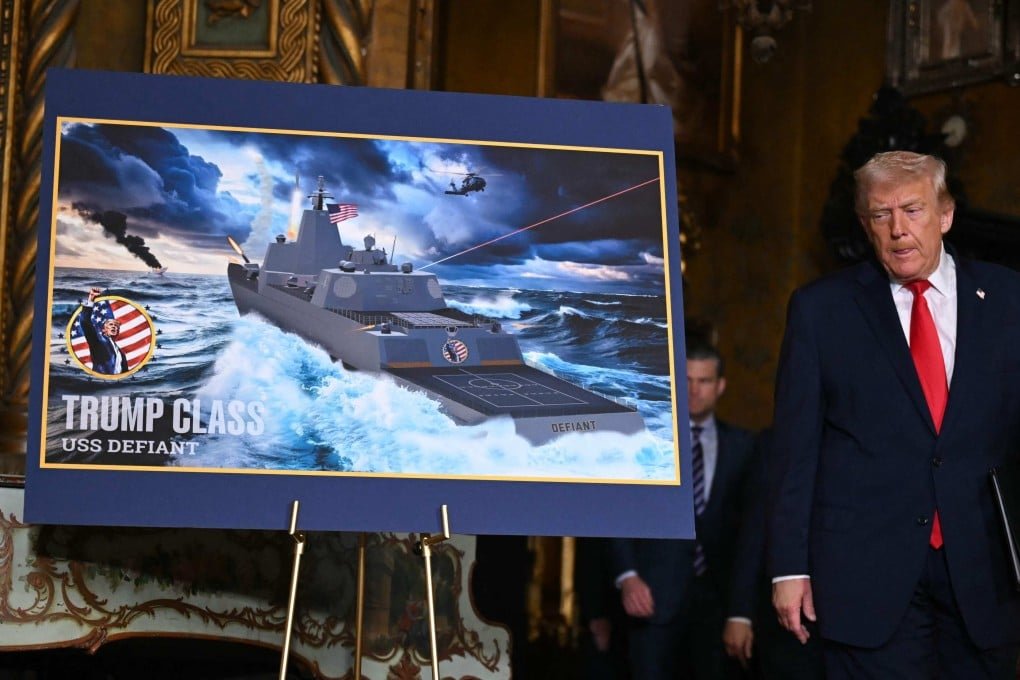
US Navy ‘Golden Fleet’ plan raises doubts over new Trump-class battleship concept
Proposed BBG(X) nuclear-powered strike ships aimed at China deterrence face questions over cost, survivability, and industrial feasibility
The United States Navy’s long-term shipbuilding strategy has placed a proposed new class of nuclear-powered surface combatants at the center of an emerging debate over maritime deterrence against China, raising questions about cost, vulnerability, and industrial capacity.
What is confirmed is that the Navy has outlined a multi-decade shipbuilding framework extending to 2055 that includes a concept for a large guided-missile warship designated BBG(X), described as a “strike-centric arsenal ship.” The program envisions up to fifteen vessels, with initial procurement funding targeted for the late 2020s and first delivery in the mid-2030s.
The ship concept has been publicly linked to the label “Trump-class battleship” in political and media discourse, although the official designation centers on the BBG(X) program rather than a finalized class name.
The Navy has indicated that the vessels would be nuclear-powered, a choice framed as enabling greater range, sustained high-speed operations, and increased capacity for advanced missile systems.
The strategic intent behind the program reflects growing U.S. military focus on potential high-intensity conflict in the Indo-Pacific, particularly involving China’s expanding naval and missile capabilities.
The proposed ships are intended to function as heavily armed surface platforms capable of delivering large volumes of long-range precision firepower.
However, defense analysts and maritime specialists have raised significant concerns about the viability of the concept.
A central criticism is survivability in a modern contested maritime environment, where anti-ship ballistic missiles, long-range cruise missiles, and advanced surveillance networks could make large surface combatants highly detectable and vulnerable.
Another major issue is cost.
Nuclear-powered surface warships require complex propulsion systems, specialized maintenance infrastructure, and highly trained personnel.
Critics argue that the lifetime operating and sustainment costs could significantly exceed those of smaller distributed naval platforms such as submarines, unmanned surface vessels, or networked destroyers.
Industrial capacity also presents a structural constraint.
U.S. shipyards already face bottlenecks in producing and maintaining existing classes of submarines and surface combatants.
Expanding production to include a new class of nuclear-powered large surface ships would require additional workforce expansion, supplier scaling, and nuclear-qualified shipbuilding expertise, all of which are long-lead challenges.
The Navy’s broader “Golden Fleet” concept reflects a shift toward integrating new propulsion systems, increased missile density per platform, and longer-range operational endurance across its surface force.
But the introduction of a new capital ship category has reopened longstanding debates over whether concentrated high-value warships remain viable in an era of distributed sensing and precision strike warfare.
The program is still in a conceptual and planning phase, with formal procurement decisions expected in the late 2020s.
Whether the BBG(X) design proceeds as envisioned will depend on budget decisions, technological validation, and assessments of survivability against rapidly evolving anti-access and area-denial systems.
The outcome of those decisions will shape whether the United States commits to rebuilding a high-end surface battle fleet or pivots further toward distributed, lower-signature naval architectures designed to reduce exposure in contested waters.
What is confirmed is that the Navy has outlined a multi-decade shipbuilding framework extending to 2055 that includes a concept for a large guided-missile warship designated BBG(X), described as a “strike-centric arsenal ship.” The program envisions up to fifteen vessels, with initial procurement funding targeted for the late 2020s and first delivery in the mid-2030s.
The ship concept has been publicly linked to the label “Trump-class battleship” in political and media discourse, although the official designation centers on the BBG(X) program rather than a finalized class name.
The Navy has indicated that the vessels would be nuclear-powered, a choice framed as enabling greater range, sustained high-speed operations, and increased capacity for advanced missile systems.
The strategic intent behind the program reflects growing U.S. military focus on potential high-intensity conflict in the Indo-Pacific, particularly involving China’s expanding naval and missile capabilities.
The proposed ships are intended to function as heavily armed surface platforms capable of delivering large volumes of long-range precision firepower.
However, defense analysts and maritime specialists have raised significant concerns about the viability of the concept.
A central criticism is survivability in a modern contested maritime environment, where anti-ship ballistic missiles, long-range cruise missiles, and advanced surveillance networks could make large surface combatants highly detectable and vulnerable.
Another major issue is cost.
Nuclear-powered surface warships require complex propulsion systems, specialized maintenance infrastructure, and highly trained personnel.
Critics argue that the lifetime operating and sustainment costs could significantly exceed those of smaller distributed naval platforms such as submarines, unmanned surface vessels, or networked destroyers.
Industrial capacity also presents a structural constraint.
U.S. shipyards already face bottlenecks in producing and maintaining existing classes of submarines and surface combatants.
Expanding production to include a new class of nuclear-powered large surface ships would require additional workforce expansion, supplier scaling, and nuclear-qualified shipbuilding expertise, all of which are long-lead challenges.
The Navy’s broader “Golden Fleet” concept reflects a shift toward integrating new propulsion systems, increased missile density per platform, and longer-range operational endurance across its surface force.
But the introduction of a new capital ship category has reopened longstanding debates over whether concentrated high-value warships remain viable in an era of distributed sensing and precision strike warfare.
The program is still in a conceptual and planning phase, with formal procurement decisions expected in the late 2020s.
Whether the BBG(X) design proceeds as envisioned will depend on budget decisions, technological validation, and assessments of survivability against rapidly evolving anti-access and area-denial systems.
The outcome of those decisions will shape whether the United States commits to rebuilding a high-end surface battle fleet or pivots further toward distributed, lower-signature naval architectures designed to reduce exposure in contested waters.