White HouseSenateThe HouseSupreme CourtFederal ReserveDOJState DepartmentTreasuryCensusBudget OfficeTrade Representative
WashingTone
Informed by Washington, Defined by Insight
Monday, May 18, 2026
WashingTone

Union Warns of Safety Risks as Workers Rush to Recolor Reflecting Pool for Trump Event
A labor complaint over rapid environmental preparation in Washington highlights concerns about worker safety, timeline pressure, and oversight in high-profile government event staging
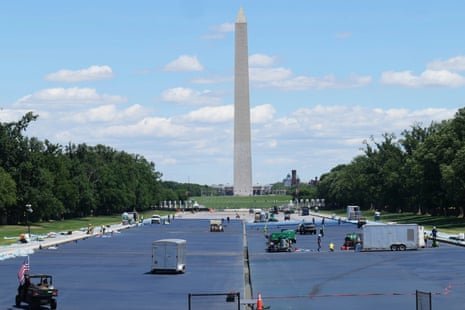
An EVENT-DRIVEN labor and safety dispute has emerged in Washington after workers were reportedly tasked with rapidly altering the appearance of the National Mall’s Reflecting Pool ahead of a Trump-associated public event, prompting union warnings about potential safety risks.
What is confirmed is that preparations were underway to modify the visual presentation of the Reflecting Pool, including efforts to enhance or alter its color in line with event staging requirements.
The work was being carried out under a compressed timeline tied to a large-scale public gathering connected to former President Donald Trump, increasing operational pressure on crews responsible for maintaining the landmark site.
The key issue raised by labor representatives is whether the pace and nature of the work could expose workers to avoidable hazards.
Concerns typically associated with such rapid environmental adjustments include chemical exposure risks, insufficient testing of materials used in large public water features, fatigue from accelerated schedules, and the challenge of maintaining standard safety protocols under deadline pressure.
The Reflecting Pool, a central feature of Washington’s National Mall, is subject to strict maintenance and environmental standards due to its visibility, public use, and symbolic importance.
Any alteration involving water treatment or coloring agents requires coordination between event organizers, facility managers, and safety personnel to ensure compliance with health and environmental regulations.
Union officials have argued that accelerated timelines tied to political or high-profile events can place workers in positions where they are pressured to prioritize speed over procedural safeguards.
Their warning highlights a broader recurring tension in large-scale public event logistics, where national landmarks are temporarily adapted for staging purposes.
Organizers of such events typically emphasize the importance of precision, security, and visual impact, particularly when involving nationally recognized public spaces.
However, these requirements can conflict with standard maintenance procedures that prioritize gradual implementation and extended safety verification periods.
The broader implication is that the use of major public infrastructure for political or ceremonial events continues to raise questions about labor protections and operational oversight.
While such transformations are common in major capitals hosting large gatherings, they often rely on tightly managed coordination between multiple agencies to avoid operational strain on frontline workers.
The situation underscores a structural challenge in event-driven use of public spaces: balancing the demands of high-visibility political staging with the occupational safety standards required for municipal workers responsible for executing rapid environmental changes.
As preparations continue, attention is focused on whether additional safeguards or schedule adjustments will be implemented to address the union’s concerns while maintaining the planned visual requirements for the event.
What is confirmed is that preparations were underway to modify the visual presentation of the Reflecting Pool, including efforts to enhance or alter its color in line with event staging requirements.
The work was being carried out under a compressed timeline tied to a large-scale public gathering connected to former President Donald Trump, increasing operational pressure on crews responsible for maintaining the landmark site.
The key issue raised by labor representatives is whether the pace and nature of the work could expose workers to avoidable hazards.
Concerns typically associated with such rapid environmental adjustments include chemical exposure risks, insufficient testing of materials used in large public water features, fatigue from accelerated schedules, and the challenge of maintaining standard safety protocols under deadline pressure.
The Reflecting Pool, a central feature of Washington’s National Mall, is subject to strict maintenance and environmental standards due to its visibility, public use, and symbolic importance.
Any alteration involving water treatment or coloring agents requires coordination between event organizers, facility managers, and safety personnel to ensure compliance with health and environmental regulations.
Union officials have argued that accelerated timelines tied to political or high-profile events can place workers in positions where they are pressured to prioritize speed over procedural safeguards.
Their warning highlights a broader recurring tension in large-scale public event logistics, where national landmarks are temporarily adapted for staging purposes.
Organizers of such events typically emphasize the importance of precision, security, and visual impact, particularly when involving nationally recognized public spaces.
However, these requirements can conflict with standard maintenance procedures that prioritize gradual implementation and extended safety verification periods.
The broader implication is that the use of major public infrastructure for political or ceremonial events continues to raise questions about labor protections and operational oversight.
While such transformations are common in major capitals hosting large gatherings, they often rely on tightly managed coordination between multiple agencies to avoid operational strain on frontline workers.
The situation underscores a structural challenge in event-driven use of public spaces: balancing the demands of high-visibility political staging with the occupational safety standards required for municipal workers responsible for executing rapid environmental changes.
As preparations continue, attention is focused on whether additional safeguards or schedule adjustments will be implemented to address the union’s concerns while maintaining the planned visual requirements for the event.