White HouseSenateThe HouseSupreme CourtFederal ReserveDOJState DepartmentTreasuryCensusBudget OfficeTrade Representative
WashingTone
Informed by Washington, Defined by Insight
Thursday, May 07, 2026
WashingTone

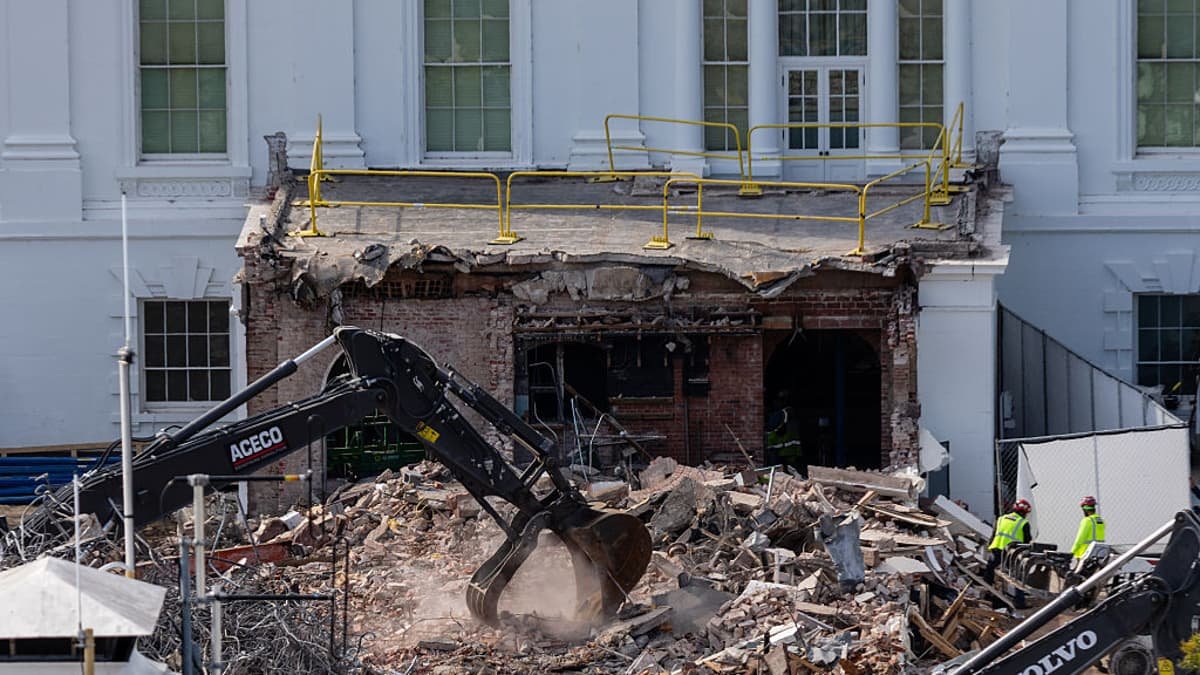
White House Ballroom Expansion Sparks Scrutiny Over Scale, Cost, and Process
The planned addition of a large-scale event space at the White House has expanded in scope, raising questions about cost controls, historical preservation constraints, and federal approval procedures
SYSTEM-DRIVEN dynamics are shaping the expansion of a planned White House ballroom project that has steadily grown in both size and projected cost, drawing attention to how major structural modifications are approved and financed within one of the most symbolically protected government buildings in the United States.
What is confirmed is that a proposal to construct or significantly expand a formal ballroom-style event space at the White House complex has evolved beyond its initial design parameters, with revisions increasing both the physical footprint and estimated budget.
The project is intended to provide a larger, purpose-built venue for official state functions, diplomatic receptions, and high-capacity ceremonial events that currently strain existing White House facilities.
The White House complex, which includes the Executive Residence and adjacent East Wing structures, has historically undergone incremental renovations rather than large-scale additions due to its protected status as both a functioning seat of government and a national historic landmark.
Any structural modification typically requires coordination among multiple federal preservation and planning bodies, along with detailed review processes intended to ensure architectural consistency and security compliance.
As the ballroom proposal has expanded, scrutiny has intensified over how design changes are being approved and how cost estimates are being managed.
Large federal construction projects of this nature generally involve phased budgeting, contractor bidding processes, and oversight mechanisms designed to prevent uncontrolled scope expansion.
In this case, the increasing scale of the project has raised questions about whether initial planning assumptions underestimated usage demands or whether design ambitions evolved after initial approval.
The underlying mechanism driving the controversy is not the existence of an event space itself, but the tension between functional modernization and institutional constraint.
The White House regularly hosts international summits, state dinners, and diplomatic receptions, many of which require temporary structures or external venues due to space limitations.
A permanent large-capacity ballroom would reduce logistical dependency but would also permanently alter the operational footprint of the executive complex.
Cost escalation has become a central point of attention because federal capital projects are typically subject to strict appropriations oversight and public justification requirements.
When projected expenses increase during planning stages, agencies are generally expected to revalidate scope, reassess contractor agreements, and, in some cases, return to approval stages depending on the magnitude of change.
Supporters of the expansion argue that the White House requires modernized infrastructure to meet contemporary diplomatic and security needs, particularly as state visits and multilateral gatherings have become more frequent and logistically complex.
Larger indoor capacity would allow for more controlled security environments and reduce reliance on external venues in Washington.
Critics focus instead on the optics and procedural implications, arguing that expanding a historically sensitive structure must be tightly controlled to prevent mission creep and preserve architectural integrity.
They also emphasize that significant cost increases in public projects require heightened transparency, especially when tied to iconic federal properties.
The project remains in a development phase, with design and budget parameters still subject to revision.
What will determine its final form is the intersection of architectural approval processes, federal funding authorization, and institutional decisions about how the White House balances modern operational needs with historical preservation obligations.
What is confirmed is that a proposal to construct or significantly expand a formal ballroom-style event space at the White House complex has evolved beyond its initial design parameters, with revisions increasing both the physical footprint and estimated budget.
The project is intended to provide a larger, purpose-built venue for official state functions, diplomatic receptions, and high-capacity ceremonial events that currently strain existing White House facilities.
The White House complex, which includes the Executive Residence and adjacent East Wing structures, has historically undergone incremental renovations rather than large-scale additions due to its protected status as both a functioning seat of government and a national historic landmark.
Any structural modification typically requires coordination among multiple federal preservation and planning bodies, along with detailed review processes intended to ensure architectural consistency and security compliance.
As the ballroom proposal has expanded, scrutiny has intensified over how design changes are being approved and how cost estimates are being managed.
Large federal construction projects of this nature generally involve phased budgeting, contractor bidding processes, and oversight mechanisms designed to prevent uncontrolled scope expansion.
In this case, the increasing scale of the project has raised questions about whether initial planning assumptions underestimated usage demands or whether design ambitions evolved after initial approval.
The underlying mechanism driving the controversy is not the existence of an event space itself, but the tension between functional modernization and institutional constraint.
The White House regularly hosts international summits, state dinners, and diplomatic receptions, many of which require temporary structures or external venues due to space limitations.
A permanent large-capacity ballroom would reduce logistical dependency but would also permanently alter the operational footprint of the executive complex.
Cost escalation has become a central point of attention because federal capital projects are typically subject to strict appropriations oversight and public justification requirements.
When projected expenses increase during planning stages, agencies are generally expected to revalidate scope, reassess contractor agreements, and, in some cases, return to approval stages depending on the magnitude of change.
Supporters of the expansion argue that the White House requires modernized infrastructure to meet contemporary diplomatic and security needs, particularly as state visits and multilateral gatherings have become more frequent and logistically complex.
Larger indoor capacity would allow for more controlled security environments and reduce reliance on external venues in Washington.
Critics focus instead on the optics and procedural implications, arguing that expanding a historically sensitive structure must be tightly controlled to prevent mission creep and preserve architectural integrity.
They also emphasize that significant cost increases in public projects require heightened transparency, especially when tied to iconic federal properties.
The project remains in a development phase, with design and budget parameters still subject to revision.
What will determine its final form is the intersection of architectural approval processes, federal funding authorization, and institutional decisions about how the White House balances modern operational needs with historical preservation obligations.