White HouseSenateThe HouseSupreme CourtFederal ReserveDOJState DepartmentTreasuryCensusBudget OfficeTrade Representative
WashingTone
Informed by Washington, Defined by Insight
Thursday, May 07, 2026
WashingTone

Trump mixes UFC spectacle with Iran diplomacy claims during Oval Office appearance
U.S. president hosted fighters in Washington while again asserting progress in talks with Tehran amid conflicting signals over nuclear tensions and ongoing conflict framing
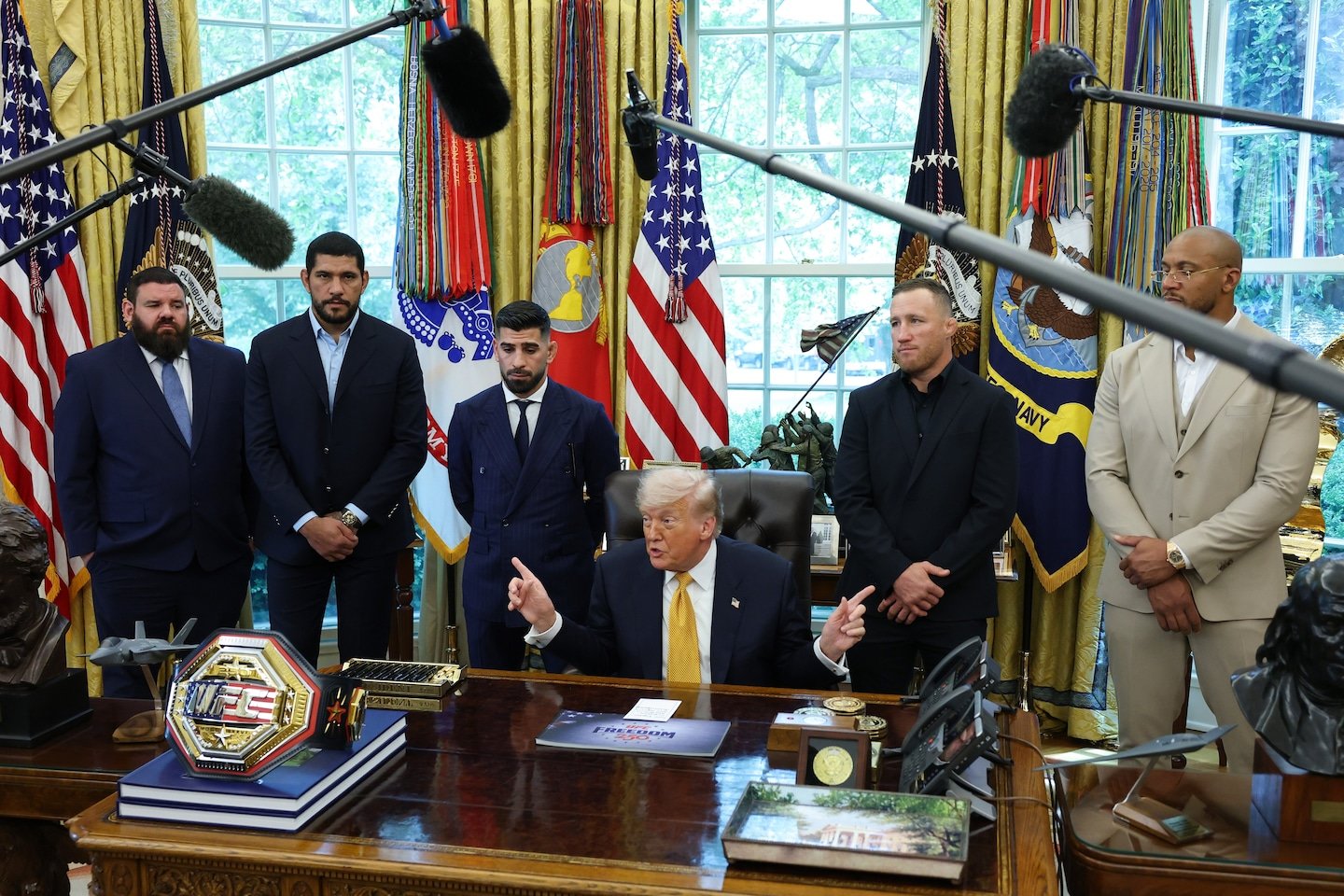
ACTOR-DRIVEN dynamics define the latest Oval Office appearance by U.S. President Donald Trump, who used a staged meeting with mixed martial arts fighters to simultaneously promote a high-profile sports event and assert progress in sensitive negotiations with Iran.
The two strands—domestic political spectacle and high-stakes foreign policy messaging—are increasingly being blended in official White House settings, creating a dual narrative that merges entertainment promotion with geopolitical signaling.
What is confirmed is that Trump hosted several prominent UFC fighters in the Oval Office on May 6, where he promoted an upcoming mixed martial arts event scheduled to take place on the White House South Lawn in June.
The event, branded as a major commemorative fight card, is being positioned as part of a broader national celebration and features planned temporary stadium infrastructure, promotional championship belts, and large-scale public viewing arrangements.
Fighters present included top-ranked athletes preparing for headline bouts, and Trump used the meeting to publicly praise them while unveiling event renderings and logistical details.
Alongside the sporting promotion, Trump addressed the ongoing confrontation with Iran, stating that discussions with Iranian representatives had been “very good” and suggesting that diplomatic progress was underway.
He framed the situation as improving compared to earlier stages of the conflict narrative he has advanced, while reiterating that preventing Iran from acquiring nuclear weapons remains a central objective.
His comments added to a series of recent public statements in which he has oscillated between assertive military rhetoric and claims of diplomatic momentum.
The broader context is a volatile information environment around U.S.–Iran relations, in which official statements, military signaling, and negotiation claims have not consistently aligned across different branches of government or public messaging channels.
Trump’s remarks during the UFC event continued that pattern, combining informal interactions with athletes and political commentary on a high-sensitivity foreign policy file.
This blending of settings has raised questions among analysts about message discipline and strategic clarity, particularly when statements about nuclear negotiations are delivered in non-diplomatic contexts.
Iran has not publicly confirmed the specific claims attributed to progress in talks, and its official position continues to emphasize that its nuclear program is for civilian purposes.
Meanwhile, U.S. messaging has varied between asserting diplomatic openings and emphasizing coercive pressure.
The result is a negotiation landscape where signaling, rather than formal agreement, dominates the public-facing narrative.
The UFC component of the Oval Office event underscores a broader pattern in Trump’s political communication style, where high-visibility cultural or sporting figures are integrated into policy-adjacent messaging.
The planned White House-hosted fight event is itself unprecedented in scale and symbolism, linking a globally popular combat sport to a federal landmark and national celebration calendar.
That convergence has intensified attention on how entertainment framing is being used alongside geopolitical messaging.
Taken together, the day’s events reflect a White House communication strategy that fuses domestic spectacle with foreign policy claims, particularly on Iran, where diplomatic progress, military pressure, and political rhetoric are being presented simultaneously.
The immediate consequence is a blurred boundary between formal state messaging and high-profile promotional events, with implications for how both international counterparts and domestic audiences interpret U.S. intentions.
The two strands—domestic political spectacle and high-stakes foreign policy messaging—are increasingly being blended in official White House settings, creating a dual narrative that merges entertainment promotion with geopolitical signaling.
What is confirmed is that Trump hosted several prominent UFC fighters in the Oval Office on May 6, where he promoted an upcoming mixed martial arts event scheduled to take place on the White House South Lawn in June.
The event, branded as a major commemorative fight card, is being positioned as part of a broader national celebration and features planned temporary stadium infrastructure, promotional championship belts, and large-scale public viewing arrangements.
Fighters present included top-ranked athletes preparing for headline bouts, and Trump used the meeting to publicly praise them while unveiling event renderings and logistical details.
Alongside the sporting promotion, Trump addressed the ongoing confrontation with Iran, stating that discussions with Iranian representatives had been “very good” and suggesting that diplomatic progress was underway.
He framed the situation as improving compared to earlier stages of the conflict narrative he has advanced, while reiterating that preventing Iran from acquiring nuclear weapons remains a central objective.
His comments added to a series of recent public statements in which he has oscillated between assertive military rhetoric and claims of diplomatic momentum.
The broader context is a volatile information environment around U.S.–Iran relations, in which official statements, military signaling, and negotiation claims have not consistently aligned across different branches of government or public messaging channels.
Trump’s remarks during the UFC event continued that pattern, combining informal interactions with athletes and political commentary on a high-sensitivity foreign policy file.
This blending of settings has raised questions among analysts about message discipline and strategic clarity, particularly when statements about nuclear negotiations are delivered in non-diplomatic contexts.
Iran has not publicly confirmed the specific claims attributed to progress in talks, and its official position continues to emphasize that its nuclear program is for civilian purposes.
Meanwhile, U.S. messaging has varied between asserting diplomatic openings and emphasizing coercive pressure.
The result is a negotiation landscape where signaling, rather than formal agreement, dominates the public-facing narrative.
The UFC component of the Oval Office event underscores a broader pattern in Trump’s political communication style, where high-visibility cultural or sporting figures are integrated into policy-adjacent messaging.
The planned White House-hosted fight event is itself unprecedented in scale and symbolism, linking a globally popular combat sport to a federal landmark and national celebration calendar.
That convergence has intensified attention on how entertainment framing is being used alongside geopolitical messaging.
Taken together, the day’s events reflect a White House communication strategy that fuses domestic spectacle with foreign policy claims, particularly on Iran, where diplomatic progress, military pressure, and political rhetoric are being presented simultaneously.
The immediate consequence is a blurred boundary between formal state messaging and high-profile promotional events, with implications for how both international counterparts and domestic audiences interpret U.S. intentions.