White HouseSenateThe HouseSupreme CourtFederal ReserveDOJState DepartmentTreasuryCensusBudget OfficeTrade Representative
WashingTone
Informed by Washington, Defined by Insight
Wednesday, May 06, 2026
WashingTone

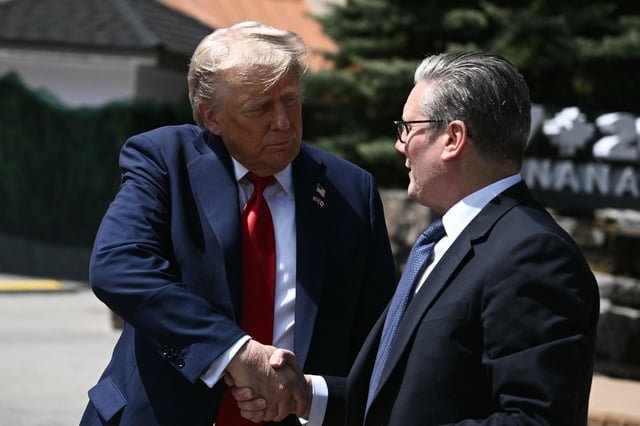
UK Exports to U.S. Drop Sharply After New U.S. Tariffs Reshape Trade Flows
A sudden policy shift in Washington cuts British shipments by a quarter, exposing vulnerability to tariff-driven disruption
U.S. trade policy—specifically a new round of broad tariffs introduced under what has been described as a “liberation day” initiative—is driving a sharp contraction in exports from the United Kingdom to the United States, with confirmed data showing a decline of roughly 25 percent in affected trade flows.
What is confirmed is that British exports to the U.S. have fallen significantly following the introduction of new tariffs across a range of industrial and manufactured goods.
The United States is one of the UK’s largest export markets, making any sudden policy shift immediately visible in trade volumes.
The decline reflects both direct price effects from tariffs and indirect disruption as buyers adjust supply chains.
The mechanism is straightforward but powerful.
Tariffs raise the cost of imported goods, making them less competitive compared with domestic alternatives or imports from countries not subject to the same measures.
U.S. importers respond by reducing orders, renegotiating contracts, or switching suppliers.
In some sectors, shipments continue but at lower margins, squeezing exporters’ profitability.
The policy shift appears to be part of a broader effort to prioritize domestic manufacturing and reduce reliance on foreign suppliers.
While such measures are often framed as temporary or corrective, their immediate impact is concentrated on trade partners with deep commercial integration, including the UK. Industries exposed to the U.S. market—such as automotive components, machinery, and specialized manufacturing—are among the most affected.
For British exporters, the consequences are immediate.
Companies face declining orders, inventory build-ups, and pressure to either absorb higher costs or pass them on to customers.
Smaller firms with limited financial buffers are particularly vulnerable, as they lack the scale to rapidly diversify into alternative markets.
The decline also highlights structural dependence.
Despite efforts to expand trade relationships globally, the U.S. remains a critical destination for high-value UK exports.
A disruption of this magnitude underscores the limits of diversification when major markets shift policy abruptly.
There are broader economic implications.
A sustained drop in exports can weigh on industrial output, employment, and investment, particularly in regions where manufacturing plays a central role.
Currency movements may partially offset the impact by making exports cheaper, but this effect is typically slower and less predictable than tariff-driven price changes.
At the diplomatic level, the development introduces tension into the transatlantic economic relationship.
The UK has positioned itself as a close economic partner to the United States, and a sudden escalation in trade barriers complicates that alignment.
Policy responses could include negotiation, targeted support for affected industries, or reciprocal measures, though escalation carries its own risks.
The immediate trajectory depends on whether the tariffs remain in place, are expanded, or are negotiated down.
In the short term, companies are adjusting logistics, pricing, and sourcing strategies to absorb the shock, while policymakers assess options to stabilize trade flows.
The confirmed outcome so far is a rapid contraction in UK exports to the U.S., demonstrating how quickly tariff policy can translate into real economic impact across integrated supply chains.
What is confirmed is that British exports to the U.S. have fallen significantly following the introduction of new tariffs across a range of industrial and manufactured goods.
The United States is one of the UK’s largest export markets, making any sudden policy shift immediately visible in trade volumes.
The decline reflects both direct price effects from tariffs and indirect disruption as buyers adjust supply chains.
The mechanism is straightforward but powerful.
Tariffs raise the cost of imported goods, making them less competitive compared with domestic alternatives or imports from countries not subject to the same measures.
U.S. importers respond by reducing orders, renegotiating contracts, or switching suppliers.
In some sectors, shipments continue but at lower margins, squeezing exporters’ profitability.
The policy shift appears to be part of a broader effort to prioritize domestic manufacturing and reduce reliance on foreign suppliers.
While such measures are often framed as temporary or corrective, their immediate impact is concentrated on trade partners with deep commercial integration, including the UK. Industries exposed to the U.S. market—such as automotive components, machinery, and specialized manufacturing—are among the most affected.
For British exporters, the consequences are immediate.
Companies face declining orders, inventory build-ups, and pressure to either absorb higher costs or pass them on to customers.
Smaller firms with limited financial buffers are particularly vulnerable, as they lack the scale to rapidly diversify into alternative markets.
The decline also highlights structural dependence.
Despite efforts to expand trade relationships globally, the U.S. remains a critical destination for high-value UK exports.
A disruption of this magnitude underscores the limits of diversification when major markets shift policy abruptly.
There are broader economic implications.
A sustained drop in exports can weigh on industrial output, employment, and investment, particularly in regions where manufacturing plays a central role.
Currency movements may partially offset the impact by making exports cheaper, but this effect is typically slower and less predictable than tariff-driven price changes.
At the diplomatic level, the development introduces tension into the transatlantic economic relationship.
The UK has positioned itself as a close economic partner to the United States, and a sudden escalation in trade barriers complicates that alignment.
Policy responses could include negotiation, targeted support for affected industries, or reciprocal measures, though escalation carries its own risks.
The immediate trajectory depends on whether the tariffs remain in place, are expanded, or are negotiated down.
In the short term, companies are adjusting logistics, pricing, and sourcing strategies to absorb the shock, while policymakers assess options to stabilize trade flows.
The confirmed outcome so far is a rapid contraction in UK exports to the U.S., demonstrating how quickly tariff policy can translate into real economic impact across integrated supply chains.