White HouseSenateThe HouseSupreme CourtFederal ReserveDOJState DepartmentTreasuryCensusBudget OfficeTrade Representative
WashingTone
Informed by Washington, Defined by Insight
Tuesday, Aug 04, 2026
WashingTone

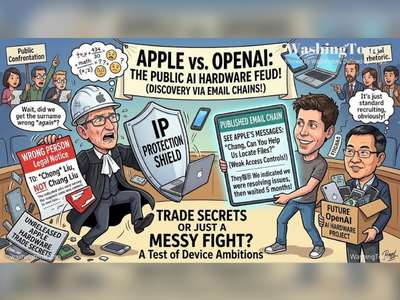
Apple Seeks Court Order to Stop OpenAI Using Alleged Trade Secrets
The iPhone maker has asked a federal judge for an injunction, accelerated evidence-gathering and broad forensic access in its case against OpenAI and former Apple hardware employees.
Apple has asked a federal judge to stop OpenAI and several former Apple employees from accessing or using what it alleges are stolen trade secrets, escalating a lawsuit that has become a direct challenge to OpenAI’s plans to build artificial-intelligence hardware.
The company filed a motion for a preliminary injunction, along with a request for expedited discovery, in its federal case against OpenAI, its hardware subsidiary io Products, former Apple executive Tang Yew Tan and former Apple engineer Chang Liu.
Apple says immediate court intervention is necessary because the alleged harm is continuing while OpenAI develops future devices.
The filing is not a ruling.
Apple’s claims have not been proven in court, and OpenAI denies possessing or wanting Apple’s trade secrets.
But the motion provides Apple’s most detailed public account so far of what it says was a coordinated effort to obtain confidential material from the iPhone maker.
Apple alleges that Liu, who worked at Apple for eight years before joining OpenAI’s technical staff, exploited an authentication flaw on at least five occasions between February and April 2026, after he had already begun working for OpenAI.
The company says he obtained thousands of pages of confidential information from Apple systems.
Apple identifies files and material relating to custom display power-management development, hardware architecture, manufacturing decisions, testing results and an unreleased Apple product’s display, touch and power systems.
It also refers to documents connected to two confidential research-and-development projects.
Apple says the named files represent only a small portion of the proprietary material it alleges Liu obtained.
The company further alleges that Liu passed a continuing stream of Apple information to OpenAI while concealing his conduct.
It says he instructed Yu-Ting “Alyssa” Peng, another former Apple employee, on how to access and copy company files without attracting the attention of Apple’s security team, and told her to communicate through the encrypted LINE messaging application.
Apple also accuses Tan, OpenAI’s chief hardware officer and a former Apple vice-president, of using the internal code name of an unannounced Apple project when seeking information from job candidates.
Messages cited by Apple refer to bringing parts worked on previously, including items described as battery components and covers.
Apple alleges that an OpenAI recruiter also advised a candidate to alert the company if asked to sign documents during an exit interview.
The motion expands Apple’s claims beyond individual files.
It alleges that OpenAI approached one of Apple’s trusted business partners to perform a proprietary metal-finishing process for OpenAI, despite knowing that the process was unique to Apple.
Apple supported that allegation with a sworn declaration from its surface-finishing manager.
Apple says it has identified 11 additional former Apple employees now working at OpenAI, beyond Liu, Tan and Peng.
The filing does not establish that all 14 engaged in misconduct.
Apple’s position is that the additional employees may hold relevant evidence or have retained proprietary information connected to the case.
The company is seeking early testimony from Liu, Tan, Peng, another unidentified former Apple employee and corporate representatives of OpenAI.
It also wants broad forensic inspection of OpenAI devices, cloud storage, Slack records, email systems and locations where Apple information may previously have been stored, including deleted material.
Apple says it offered to forgo an injunction if OpenAI agreed to five conditions.
OpenAI accepted three commitments concerning future access, ongoing use and preservation of evidence, but rejected demands that Apple’s lawyers and outside forensic specialists be allowed to examine its devices, accounts and network locations.
OpenAI has called Apple’s request unnecessary and based on false information.
It says it does not have or want Apple’s trade secrets, and has published messages and emails that it says challenge Apple’s account of the dispute.
The court is scheduled to hear Apple’s injunction request on 1 October 2026 before Judge Edward J. Davila.
The company filed a motion for a preliminary injunction, along with a request for expedited discovery, in its federal case against OpenAI, its hardware subsidiary io Products, former Apple executive Tang Yew Tan and former Apple engineer Chang Liu.
Apple says immediate court intervention is necessary because the alleged harm is continuing while OpenAI develops future devices.
The filing is not a ruling.
Apple’s claims have not been proven in court, and OpenAI denies possessing or wanting Apple’s trade secrets.
But the motion provides Apple’s most detailed public account so far of what it says was a coordinated effort to obtain confidential material from the iPhone maker.
Apple alleges that Liu, who worked at Apple for eight years before joining OpenAI’s technical staff, exploited an authentication flaw on at least five occasions between February and April 2026, after he had already begun working for OpenAI.
The company says he obtained thousands of pages of confidential information from Apple systems.
Apple identifies files and material relating to custom display power-management development, hardware architecture, manufacturing decisions, testing results and an unreleased Apple product’s display, touch and power systems.
It also refers to documents connected to two confidential research-and-development projects.
Apple says the named files represent only a small portion of the proprietary material it alleges Liu obtained.
The company further alleges that Liu passed a continuing stream of Apple information to OpenAI while concealing his conduct.
It says he instructed Yu-Ting “Alyssa” Peng, another former Apple employee, on how to access and copy company files without attracting the attention of Apple’s security team, and told her to communicate through the encrypted LINE messaging application.
Apple also accuses Tan, OpenAI’s chief hardware officer and a former Apple vice-president, of using the internal code name of an unannounced Apple project when seeking information from job candidates.
Messages cited by Apple refer to bringing parts worked on previously, including items described as battery components and covers.
Apple alleges that an OpenAI recruiter also advised a candidate to alert the company if asked to sign documents during an exit interview.
The motion expands Apple’s claims beyond individual files.
It alleges that OpenAI approached one of Apple’s trusted business partners to perform a proprietary metal-finishing process for OpenAI, despite knowing that the process was unique to Apple.
Apple supported that allegation with a sworn declaration from its surface-finishing manager.
Apple says it has identified 11 additional former Apple employees now working at OpenAI, beyond Liu, Tan and Peng.
The filing does not establish that all 14 engaged in misconduct.
Apple’s position is that the additional employees may hold relevant evidence or have retained proprietary information connected to the case.
The company is seeking early testimony from Liu, Tan, Peng, another unidentified former Apple employee and corporate representatives of OpenAI.
It also wants broad forensic inspection of OpenAI devices, cloud storage, Slack records, email systems and locations where Apple information may previously have been stored, including deleted material.
Apple says it offered to forgo an injunction if OpenAI agreed to five conditions.
OpenAI accepted three commitments concerning future access, ongoing use and preservation of evidence, but rejected demands that Apple’s lawyers and outside forensic specialists be allowed to examine its devices, accounts and network locations.
OpenAI has called Apple’s request unnecessary and based on false information.
It says it does not have or want Apple’s trade secrets, and has published messages and emails that it says challenge Apple’s account of the dispute.
The court is scheduled to hear Apple’s injunction request on 1 October 2026 before Judge Edward J. Davila.