White HouseSenateThe HouseSupreme CourtFederal ReserveDOJState DepartmentTreasuryCensusBudget OfficeTrade Representative
WashingTone
Informed by Washington, Defined by Insight
Tuesday, Aug 04, 2026
WashingTone

Apple’s OpenAI Lawsuit Becomes a Public Fight Over AI Hardware
OpenAI has answered Apple’s trade-secrets allegations with published emails and messages, turning a dispute over former employees into a test of both companies’ device ambitions.
Apple’s trade-secrets lawsuit against OpenAI has become a public confrontation over emails, employee access and the future of artificial-intelligence hardware.
Apple alleges that OpenAI and former Apple employees took confidential information to support the development of new devices.
OpenAI denies that claim and has released correspondence it says exposes errors in Apple’s account of how the dispute began.
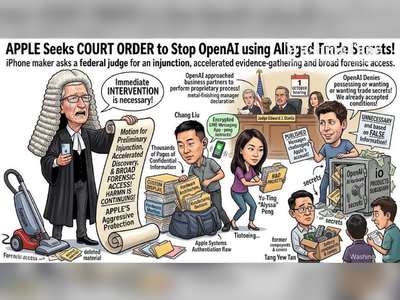
The case, filed in federal court in California in July, names OpenAI, its chief hardware officer Tang Tan and former Apple engineer Chang Liu.
Apple alleges that Tan and Liu misused confidential material relating to unreleased hardware, engineering, supply-chain and product-development work.
It also claims that OpenAI encouraged conduct that went beyond ordinary recruiting competition, including seeking proprietary information and physical Apple components from candidates.
Those are serious allegations, and they have not been resolved by a court.
Trade-secrets cases often turn on documents, access records and testimony that are not yet public.
Apple has said it is acting to protect the work of its employees and its intellectual property; OpenAI says it has no interest in Apple’s secrets and that the lawsuit rests on a distorted account of the facts.
OpenAI’s unusually direct public response has shifted the argument.
The company says Apple claimed it first contacted OpenAI in February and received no reply, but that Apple’s outside lawyers had sent a legal message to the wrong person after confusing two similar Asian surnames.
OpenAI also says Apple later conceded that an alleged conversation with OpenAI’s general counsel never occurred.
The artificial-intelligence company has published an email chain and messages that it says support those assertions.
It says Apple indicated at one stage that it was resolving any issues, then did not raise the specific allegations set out in the lawsuit for about five months.
Apple’s legal claims, however, extend beyond that early exchange, and the correspondence alone does not determine whether confidential information was improperly accessed or used.
Liu’s departure has become another point of dispute.
Apple alleges that he retained and accessed confidential information after leaving.
OpenAI says messages show Apple employees contacting Liu for help locating internal files and answering technical questions after his final day.
It also points to a message in which Liu asked former colleagues to sign out of his iMessage account on Apple equipment so that information from his new employer would not appear there.
OpenAI presents those exchanges as evidence of weak access controls inside Apple.
Apple presents the same period as evidence that a former employee retained access to systems and material he should no longer have had.
The distinction matters: an access failure can be a security problem, but it does not by itself settle whether someone took or exploited trade secrets.
The legal clash is unusually charged because Apple and OpenAI were recently collaborators.
Apple incorporated ChatGPT as an optional outside tool in parts of its consumer artificial-intelligence offering.
Their relationship has since become more complicated as OpenAI moves beyond software and into devices, recruiting experienced Apple hardware and design talent.
Tan spent more than two decades at Apple before joining OpenAI.
The company has also brought in Jony Ive, Apple’s former design chief, through its acquisition of his hardware venture.
OpenAI has said it is working on a family of devices, although it has not yet released a consumer product or publicly detailed what the first one will be.
That creates a genuine strategic tension.
Apple’s business still depends heavily on the iPhone, while OpenAI is exploring whether artificial intelligence can support new kinds of personal computing products.
But there is no established evidence that Apple filed the lawsuit to suppress a future OpenAI device, or that any unreleased product is capable of replacing the iPhone.
Those are competitive possibilities, not findings in the case.
The dispute also arrives during a consequential leadership transition at Apple.
Tim Cook is due to become executive chairman, while John Ternus, a longtime hardware leader, is set to become chief executive.
The timing gives the lawsuit an added symbolic force: Apple is defending the machinery behind its most valuable products just as OpenAI is assembling a hardware operation of its own.
For now, the immediate question is narrower than the rhetoric surrounding it.
Apple is seeking court intervention over its allegations, while OpenAI is contesting both the facts and the premise of the case.
The public exchange has made the conflict louder, but the decisive test will come through evidence, discovery and a judge’s scrutiny.
Apple alleges that OpenAI and former Apple employees took confidential information to support the development of new devices.
OpenAI denies that claim and has released correspondence it says exposes errors in Apple’s account of how the dispute began.
The case, filed in federal court in California in July, names OpenAI, its chief hardware officer Tang Tan and former Apple engineer Chang Liu.
Apple alleges that Tan and Liu misused confidential material relating to unreleased hardware, engineering, supply-chain and product-development work.
It also claims that OpenAI encouraged conduct that went beyond ordinary recruiting competition, including seeking proprietary information and physical Apple components from candidates.
Those are serious allegations, and they have not been resolved by a court.
Trade-secrets cases often turn on documents, access records and testimony that are not yet public.
Apple has said it is acting to protect the work of its employees and its intellectual property; OpenAI says it has no interest in Apple’s secrets and that the lawsuit rests on a distorted account of the facts.
OpenAI’s unusually direct public response has shifted the argument.
The company says Apple claimed it first contacted OpenAI in February and received no reply, but that Apple’s outside lawyers had sent a legal message to the wrong person after confusing two similar Asian surnames.
OpenAI also says Apple later conceded that an alleged conversation with OpenAI’s general counsel never occurred.
The artificial-intelligence company has published an email chain and messages that it says support those assertions.
It says Apple indicated at one stage that it was resolving any issues, then did not raise the specific allegations set out in the lawsuit for about five months.
Apple’s legal claims, however, extend beyond that early exchange, and the correspondence alone does not determine whether confidential information was improperly accessed or used.
Liu’s departure has become another point of dispute.
Apple alleges that he retained and accessed confidential information after leaving.
OpenAI says messages show Apple employees contacting Liu for help locating internal files and answering technical questions after his final day.
It also points to a message in which Liu asked former colleagues to sign out of his iMessage account on Apple equipment so that information from his new employer would not appear there.
OpenAI presents those exchanges as evidence of weak access controls inside Apple.
Apple presents the same period as evidence that a former employee retained access to systems and material he should no longer have had.
The distinction matters: an access failure can be a security problem, but it does not by itself settle whether someone took or exploited trade secrets.
The legal clash is unusually charged because Apple and OpenAI were recently collaborators.
Apple incorporated ChatGPT as an optional outside tool in parts of its consumer artificial-intelligence offering.
Their relationship has since become more complicated as OpenAI moves beyond software and into devices, recruiting experienced Apple hardware and design talent.
Tan spent more than two decades at Apple before joining OpenAI.
The company has also brought in Jony Ive, Apple’s former design chief, through its acquisition of his hardware venture.
OpenAI has said it is working on a family of devices, although it has not yet released a consumer product or publicly detailed what the first one will be.
That creates a genuine strategic tension.
Apple’s business still depends heavily on the iPhone, while OpenAI is exploring whether artificial intelligence can support new kinds of personal computing products.
But there is no established evidence that Apple filed the lawsuit to suppress a future OpenAI device, or that any unreleased product is capable of replacing the iPhone.
Those are competitive possibilities, not findings in the case.
The dispute also arrives during a consequential leadership transition at Apple.
Tim Cook is due to become executive chairman, while John Ternus, a longtime hardware leader, is set to become chief executive.
The timing gives the lawsuit an added symbolic force: Apple is defending the machinery behind its most valuable products just as OpenAI is assembling a hardware operation of its own.
For now, the immediate question is narrower than the rhetoric surrounding it.
Apple is seeking court intervention over its allegations, while OpenAI is contesting both the facts and the premise of the case.
The public exchange has made the conflict louder, but the decisive test will come through evidence, discovery and a judge’s scrutiny.