White HouseSenateThe HouseSupreme CourtFederal ReserveDOJState DepartmentTreasuryCensusBudget OfficeTrade Representative
WashingTone
Informed by Washington, Defined by Insight
Sunday, Aug 09, 2026
WashingTone

AI’s Next Bottleneck Is Power, Not Just Nvidia Chips
As data centres multiply, technology companies are competing for electricity, grid connections and round-the-clock generation.
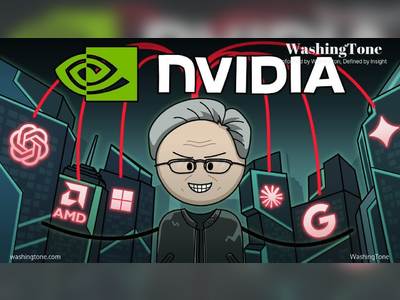
Nvidia may supply the chips that power much of the artificial-intelligence boom, but no company “owns” AI. The industry depends on a longer chain: chip designers, cloud providers, data-centre builders, network operators, utilities, fuel suppliers, grid planners and governments that decide where new power lines and generation can be built.
Increasingly, the scarce part of that chain is electricity that is available in the right place, at the right time.
AI runs in data centres: large buildings packed with servers, networking equipment and cooling systems.
Training and operating advanced models requires vast clusters of specialised chips working continuously.
The chips are expensive, but they cannot produce an answer, image or prediction without power and a connection to the grid.
The scale is moving quickly.
The International Energy Agency projects global electricity use by data centres will rise from about 460 terawatt-hours in 2024 to more than 1,000 terawatt-hours in 2030 in its base-case outlook.
A terawatt-hour is one billion kilowatt-hours.
The agency’s projection is not a certainty; it depends on how rapidly AI is adopted, how efficiently systems improve and how much infrastructure actually gets built.
But it captures a change already visible in utility planning: data centres are becoming major industrial customers.
That changes who has leverage.
A leading chipmaker profits when customers buy more computing equipment.
A cloud company profits when it rents that computing capacity.
But an AI campus also needs land, substations, transmission lines, water or other cooling arrangements, permits and long-term electricity contracts.
A project can have financing and a queue of customers yet still wait years for a grid connection.
The result is a rush for dependable power.
Technology companies have pursued renewable-energy contracts, natural-gas-backed capacity and nuclear agreements in an effort to secure electricity with lower carbon emissions and around-the-clock availability.
Microsoft’s 20-year agreement with Constellation is intended to support the restart of Unit 1 at Pennsylvania’s Three Mile Island site, now called the Crane Clean Energy Center.
Constellation has said the restarted unit could add about 835 megawatts of carbon-free capacity to the grid, subject to the work and approvals required for a planned 2027 return.
Google has made a separate agreement with Kairos Power to develop a fleet of advanced nuclear projects totaling 500 megawatts by 2035. That agreement is a pathway, not power already flowing to data centres.
Its value lies in what it signals: large technology companies are no longer treating electricity as a routine bill paid after construction.
They are trying to help secure future generation years before their data centres need it.
Utilities are central to this story, but they do not simply own an unlimited reservoir of electrons.
They must balance new industrial demand with reliability for homes, hospitals and existing businesses.
New transmission and generation can take years to permit and construct.
In some regions, the cost of grid upgrades and the terms for connecting large new loads are becoming contentious public questions.
There is also a climate tension.
AI can help utilities forecast demand, manage grids and improve industrial efficiency.
At the same time, a rapid buildout of data centres can increase demand for gas-fired generation where clean power and transmission are not ready.
Whether AI’s energy footprint becomes cleaner or dirtier will depend less on slogans than on the generation mix, the speed of grid construction and the efficiency of the models and hardware being deployed.
The more accurate answer to who profits from AI is therefore plural.
Nvidia remains a critical supplier, while cloud platforms sell access to compute and data-centre developers build the physical factories of the AI economy.
But electricity providers, grid owners, nuclear developers, renewable developers and equipment makers are becoming indispensable partners.
The next AI race will be fought not only over faster chips, but over who can deliver reliable power to the places where those chips are installed.
Increasingly, the scarce part of that chain is electricity that is available in the right place, at the right time.
AI runs in data centres: large buildings packed with servers, networking equipment and cooling systems.
Training and operating advanced models requires vast clusters of specialised chips working continuously.
The chips are expensive, but they cannot produce an answer, image or prediction without power and a connection to the grid.
The scale is moving quickly.
The International Energy Agency projects global electricity use by data centres will rise from about 460 terawatt-hours in 2024 to more than 1,000 terawatt-hours in 2030 in its base-case outlook.
A terawatt-hour is one billion kilowatt-hours.
The agency’s projection is not a certainty; it depends on how rapidly AI is adopted, how efficiently systems improve and how much infrastructure actually gets built.
But it captures a change already visible in utility planning: data centres are becoming major industrial customers.
That changes who has leverage.
A leading chipmaker profits when customers buy more computing equipment.
A cloud company profits when it rents that computing capacity.
But an AI campus also needs land, substations, transmission lines, water or other cooling arrangements, permits and long-term electricity contracts.
A project can have financing and a queue of customers yet still wait years for a grid connection.
The result is a rush for dependable power.
Technology companies have pursued renewable-energy contracts, natural-gas-backed capacity and nuclear agreements in an effort to secure electricity with lower carbon emissions and around-the-clock availability.
Microsoft’s 20-year agreement with Constellation is intended to support the restart of Unit 1 at Pennsylvania’s Three Mile Island site, now called the Crane Clean Energy Center.
Constellation has said the restarted unit could add about 835 megawatts of carbon-free capacity to the grid, subject to the work and approvals required for a planned 2027 return.
Google has made a separate agreement with Kairos Power to develop a fleet of advanced nuclear projects totaling 500 megawatts by 2035. That agreement is a pathway, not power already flowing to data centres.
Its value lies in what it signals: large technology companies are no longer treating electricity as a routine bill paid after construction.
They are trying to help secure future generation years before their data centres need it.
Utilities are central to this story, but they do not simply own an unlimited reservoir of electrons.
They must balance new industrial demand with reliability for homes, hospitals and existing businesses.
New transmission and generation can take years to permit and construct.
In some regions, the cost of grid upgrades and the terms for connecting large new loads are becoming contentious public questions.
There is also a climate tension.
AI can help utilities forecast demand, manage grids and improve industrial efficiency.
At the same time, a rapid buildout of data centres can increase demand for gas-fired generation where clean power and transmission are not ready.
Whether AI’s energy footprint becomes cleaner or dirtier will depend less on slogans than on the generation mix, the speed of grid construction and the efficiency of the models and hardware being deployed.
The more accurate answer to who profits from AI is therefore plural.
Nvidia remains a critical supplier, while cloud platforms sell access to compute and data-centre developers build the physical factories of the AI economy.
But electricity providers, grid owners, nuclear developers, renewable developers and equipment makers are becoming indispensable partners.
The next AI race will be fought not only over faster chips, but over who can deliver reliable power to the places where those chips are installed.